
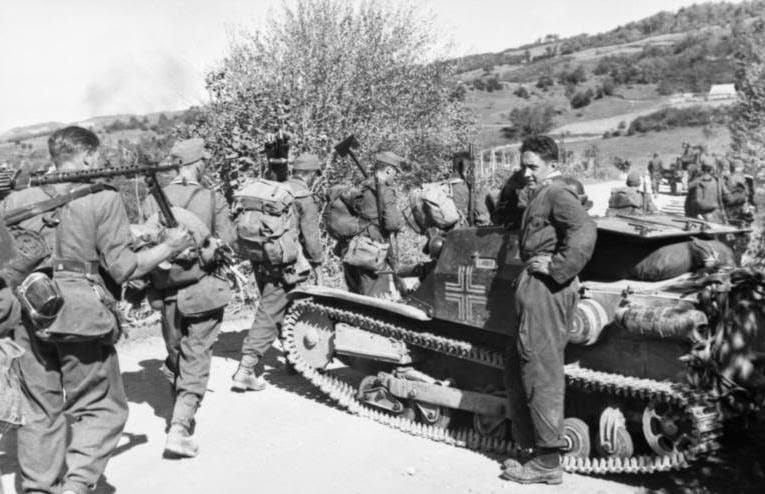
After the surrender of the Italian Army in September 1943, Albania was occupied by the Germans
With the collapse of the Mussolini government in line with the Allied invasion of Italy, Germany occupied Albania in September 1943, dropping paratroopers into Tirana before the Albanian guerrillas could take the capital. The German Army soon drove the guerrillas into the hills and to the south.
The Nazi German government subsequently announced it would recognize the independence of a neutral Albania and set about organizing a new government, police and armed forces. The Germans did not exert heavy-handed control over Albania’s administration. Rather, they sought to gain popular support by backing causes popular with Albanians, especially the annexation of Kosovo.
Many Balli Kombëtar units cooperated with the Germans against the communists and several Balli Kombëtar leaders held positions in the German-sponsored regime. Albanian collaborators, especially the Skanderbeg SS Division, also expelled and killed Serbs living in Kosovo.
In December 1943, a third resistance organization, an anticommunist, anti-German royalist group known as Legaliteti, took shape in Albania’s northern mountains. Led by Abaz Kupi, it largely consisted of Geg guerrillas, supplied mainly with weapons from the allies, who withdrew their support for the NLM after the communists renounced Albania’s claims on Kosovo.
The capital Tirana was liberated by the partisans on 17 November 1944 after a 20-day battle. The communist partizans entirely liberated Albania from German occupation on 29 November 1944, pursuing the German army till Višegrad, Bosnia (then Yugoslavia) in collaboration with the Yugoslav communist forces.
The Albanian partisans also liberated Kosovo, part of Montenegro, and southern Bosnia and Herzegovina. By November 1944, they had thrown out the Germans, being with Yugoslavia the only European nations to do so without any assistance from the allies.