
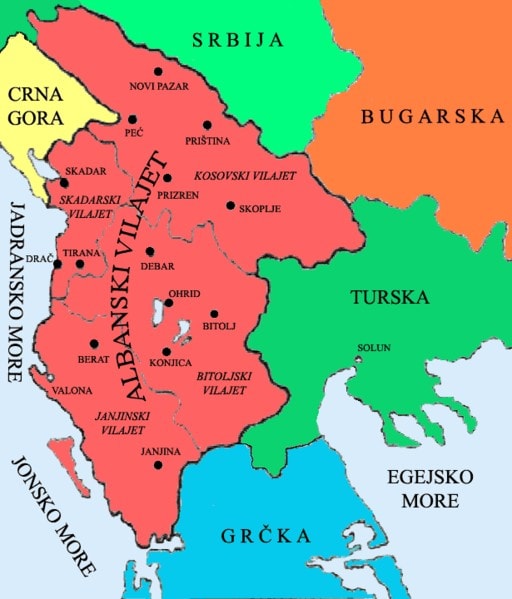
By the 1870s, the Sublime Porte’s reforms aimed at checking the Ottoman Empire’s disintegration had clearly failed
The image of the “Turkish yoke” had become fixed in the nationalist mythologies and psyches of the empire’s Balkan peoples, and their march toward independence quickened.
The Albanians, because of the higher degree of Islamic influence, their internal social divisions, and the fear that they would lose their Albanian-populated lands to the emerging Balkan states—Serbia, Montenegro, Bulgaria, and Greece—were the last of the Balkan peoples to desire division from the Ottoman Empire.
However, in the 19th century after the fall of the Albanian pashaliks and the Massacre of the Albanian Beys an Albanian National Awakening took place and many revolts against the Ottoman Empire were organized. Such revolts included the Albanian Revolts of 1833-1839, the Revolt of 1843–44, and the Revolt of 1847.
A culmination of the Albanian National Awakening were the League of Prizren and the League of Peja, but they were unsuccessful to an Albanian independence, which occurred only in 1912, through the Albanian Declaration of Independence.