
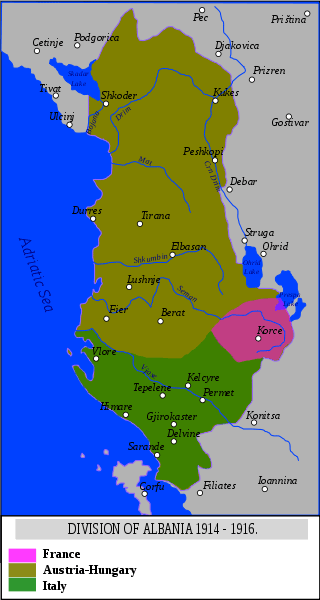
World War I interrupted all government activities in Albania, while the country was split in a number of regional governments.
Political chaos engulfed Albania after the outbreak of World War I. The Albanian people split along religious and tribal lines after the prince’s departure. Muslims demanded a Muslim prince and looked to Turkey as the protector of the privileges they had enjoyed. Other Albanians looked to Italy and Serbia for support.
Still others, including many beys and clan chiefs, recognized no superior authority.
Prince William left Albania on 3 September 1914, as a result of the Peasant Revolt initiated by Essad Pasha and later taken over by Haxhi Qamili. William subsequently joined the German army and served on the Eastern Front, but never renounced his claim to the throne.
In the country’s south, the local Greek population, revolted against the incorporation of the area into the new Albanian state and declared the Autonomous Republic of Northern Epirus at 28 February.
In late 1914, Greece occupied southern Albania, including Korçë and Gjirokastër. Italy occupied Vlorë, and Serbia and Montenegro occupied parts of northern Albania until a Central Powers offensive scattered the Serbian army, which was evacuated by the French to Thessaloniki.
Austro-Hungarian and Bulgarian forces then occupied about two-thirds of the country (Bulgarian occupation of Albania). Under the secret Treaty of London signed in April 1915, Triple Entente powers promised Italy that it would gain Vlorë (Valona) and nearby lands and a protectorate over Albania in exchange for entering the war against Austria-Hungary.
Serbia and Montenegro were promised much of northern Albania, and Greece was promised much of the country’s southern half. The treaty left a tiny Albanian state that would be represented by Italy in its relations with the other major powers.
In September 1918, Entente forces broke through the Central Powers’ lines north of Thessaloniki and within days Austro-Hungarian forces began to withdraw from Albania. On October 2, 1918 the city of Durrës was shelled on the orders of Louis Franchet d’Espèrey, during the Battle of Durazzo: according to d’Espèrey, the Port of Durrës, if not destroyed, would have served the evacuation of the Bulgarian and German armies, involved in World War I.
When the war ended on 11 November 1918, Italy’s army had occupied most of Albania; Serbia held much of the country’s northern mountains; Greece occupied a sliver of land within Albania’s 1913 borders; and French forces occupied Korçë and Shkodër as well as other regions with sizable Albanian populations.