
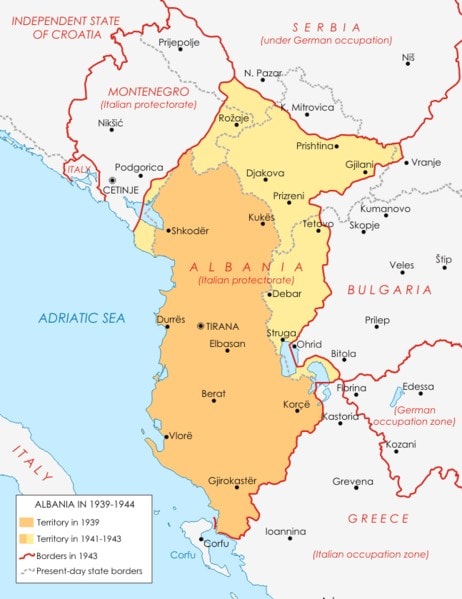
On 7 April Mussolini’s troops invaded Albania
The operation was led by General Alfredo Guzzoni. The invasion force was divided into three groups, which were to land successively. The most important was the first group, which was divided in four columns, each assigned to a landing area at a harbor and an inland target on which to advance.
Despite some stubborn resistance by some patriots, especially at Durrës, the Italians made short work of the Albanians. Durrës was captured on 7 April, Tirana the following day, Shkodër and Gjirokastër on 9 April, and almost the entire country by 10 April.
Unwilling to become an Italian puppet, King Zog, his wife, Queen Geraldine Apponyi, and their infant son Leka fled to Greece and eventually to London.
On 12 April, the Albanian parliament voted to depose Zog and unite the nation with Italy “in personal union” by offering the Albanian crown to Victor Emmanuel III.
We parliament elected Albania’s largest landowner, Shefqet Bej Verlaci, as Prime Minister
Verlaci additionally served as head of state for five days until Victor Emmanuel III formally accepted the Albanian crown in a ceremony at the Quirinale palace in Rome. Victor Emmanuel III appointed Francesco Jacomoni di San Savino, a former ambassador to Albania, to represent him in Albania as “Lieutenant-General of the King” (effectively a viceroy).
Albania under Italy
While Victor Emmanuel ruled as king, Shefqet Bej Verlaci served as the Prime Minister. Shefqet Verlaci controlled the day-to-day activities of the Italian protectorate. On 3 December 1941, Shefqet Bej Verlaci was replaced as Prime Minister and Head of State by Mustafa Merlika Kruja. From the start, Albanian foreign affairs, customs, as well as natural resources came under direct control of Italy.
The puppet Albanian Fascist Party became the ruling party of the country and the Fascists allowed Italian citizens to settle in Albania and to own land so that they could gradually transform it into Italian soil. In October 1940, during the Greco-Italian War, Albania served as a staging-area for Italian dictator Benito Mussolini’s unsuccessful invasion of Greece.
Mussolini planned to invade Greece and other countries like Yugoslavia in the area to give Italy territorial control of most of the Mediterranean Sea coastline, as part of the Fascists objective of creating the objective of Mare Nostrum (“Our Sea”) in which Italy would dominate the Mediterranean.
But, soon after the Italian invasion, the Greeks counter-attacked and a sizeable portion of Albania was in Greek hands (including the cities of Gjirokastër and Korçë).
In April 1941, after Greece capitulated to the German forces, the Greek territorial gains in southern Albania returned to Italian command. Under Italian command came also large areas of Greece after the successful German invasion of Greece.
After the fall of Yugoslavia and Greece in April 1941, the Italian Fascists added to the territory of the Kingdom of Albania most of the Albanian-inhabited areas that had been previously given to the Kingdom of Yugoslavia.
The Albanian fascists claimed in May 1941 that nearly all the Albanian populated territories were united to Albania
Even areas of northern Greece (Chameria) were administered by Albanians. But this was even a consequence of borders that Italy and Germany agreed on when dividing their spheres of influence. Some small portions of territories with Albanian majority remained outside the new borders and contact between the two parts was practically impossible: the Albanian population under the Bulgarian rule was heavily oppressed.