
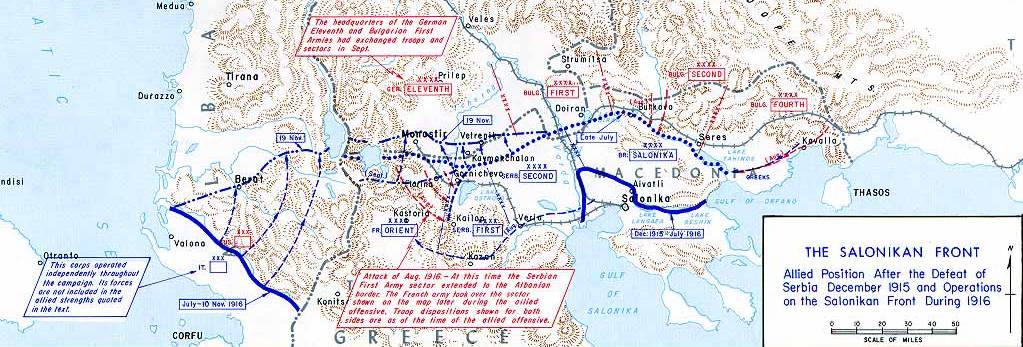
After World War I, Albania was still under the occupation of Serbian and Italian forces
It was a rebellion of the respective populations of Northern and Southern Albania that pushed back the Serbs and Italians behind the recognized borders of Albania. Albania’s political confusion continued in the wake of World War I.
The country lacked a single recognized government, and Albanians feared, with justification, that Italy, Yugoslavia, and Greece would succeed in extinguishing Albania’s independence and carve up the country. Italian forces controlled Albanian political activity in the areas they occupied.
The Serbs, who largely dictated Yugoslavia’s foreign policy after World War I, strove to take over northern Albania, and the Greeks sought to control southern Albania. A delegation sent by a postwar Albanian National Assembly that met at Durrës in December 1918 defended Albanian interests at the Paris Peace Conference, but the conference denied Albania official representation.
The National Assembly, anxious to keep Albania intact, expressed willingness to accept Italian protection and even an Italian prince as a ruler so long as it would mean Albania did not lose territory. Serbian troops conducted actions in Albanian-populated border areas, while Albanian guerrillas operated in both Serbia and Montenegro.
In January 1920, at the Paris Peace Conference, negotiators from France, Britain, and Greece agreed to divide Albania among Yugoslavia, Italy, and Greece as a diplomatic expedient aimed at finding a compromise solution to the territorial conflict between Italy and Yugoslavia. The deal was done behind the Albanians’ backs. Members of a second Albanian National Assembly held at Lushnjë in January 1920 rejected the partition plan and warned that Albanians would take up arms to defend their country’s independence and territorial integrity.
The Lushnjë National Assembly appointed a four-man regency to rule the country
A bicameral parliament was also created, in which an elected lower chamber, the Chamber of Deputies (with one deputy for every 12,000 people in Albania and one for the Albanian community in the United States), appointed members of its own ranks to an upper chamber, the Senate.
In February 1920, the government moved to Tirana, which became Albania’s capital. One month later, in March 1920, U.S. President Woodrow Wilson intervened to block the Paris agreement.
The United States underscored its support for Albania’s independence by recognizing an official Albanian representative to Washington, and in December the League of Nations recognized Albania’s sovereignty by admitting it as a full member.
The country’s borders, however, remained unsettled
Albania achieved a degree of statehood after World War I, in part because of the diplomatic intercession of the United States. The country suffered from a debilitating lack of economic and social development, however, and its first years of independence were fraught with political instability.
Unable to survive a predatory environment without a foreign protector, Albania became the object of tensions between Italy and the Kingdom of Serbs, Croats and Slovenes, which both sought to dominate the country.